
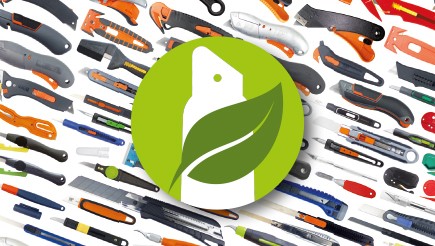
Every day, thousands of professionals—forklift operators, order pickers, logistics workers, industrial operators, etc.—use a safety cutter to open boxes, slice film, and cut packaging materials. These are routine actions, repeated dozens of times a day.
What is less visible is what lies behind this tool—that is, the raw materials used to manufacture it, the energy consumed, and the resources committed. This is precisely where Mure & Peyrot has decided to take action.
Our CSR Approach
CSR (Corporate Social Responsibility) has been at the heart of our strategy for many years. At Mure & Peyrot, it translates into concrete, measurable choices integrated directly into our manufacturing process.
For several years, we have been working to reduce the carbon footprint of our products. One of the most significant advances is the integration of recycled materials into the manufacture of our safety knives.
In practice, the polymer components of our knives—the body and handle of the tool—are partially manufactured using recycled polyamides. Only these parts are involved: our cutter blades retain their original composition to ensure the same cutting quality. These materials come from two potential sources: our own production waste, or residues from the textile industry, specifically spinning mills. In both cases, they are collected, reprocessed within recycling streams, and reintegrated into a new manufacturing cycle, thereby preventing disposal and reducing the reliance on virgin raw materials.
Up to 20% Recycled Materials: Controlled Integration
Integrating recycled materials into an industrial product cannot be improvised. It is not enough to mix salvaged materials and hope the result meets standards. It is a rigorous, controlled, and measured process.
Our safety knives incorporate up to 20% recycled materials in their composition. This rate is not chosen at random. It represents the equilibrium point we have identified between environmental benefit and the maintenance of technical performance.
Indeed, the proportion of recycled material influences the final characteristics of the product. This is why we precisely measure this share at every stage of production. Every batch is inspected. Nothing is left to chance.
And what about quality?
This is a legitimate question that any professional is entitled to ask. Is a knife made with recycled materials as reliable as one made with virgin raw materials?
The answer is yes, provided the integration is carried out correctly. And that is precisely what we are working on.
Our knives are professional safety tools. Like any professional cutter, they must withstand intensive use, provide a secure and stable grip, and ensure effective protection for the user. These requirements are non-negotiable.
The choice of a 20% maximum rate is precisely the result of this balancing act. It is sufficient to have a real environmental impact, yet calculated to never compromise the robustness and reliability of the final product. Mechanical properties remain unchanged.
In short, the partially recycled knife you hold in your hand is just as robust, reliable, and safe as its traditional equivalent.
An environmental approach
Integrating recycled materials into our safety knives is an initial step in a broader initiative. We continue to work on optimizing our processes, developing the materials we use, and reducing our overall environmental footprint, in full alignment with our CSR commitments.
We are moving forward progressively and transparently because we believe that sustainability is built over the long term.
CONCLUSION
By opting for a Mure & Peyrot safety knife incorporating recycled materials, you do not compromise on performance. You choose a tool that meets your professional requirements while contributing, at your level, to a more responsible industry.
Performance and responsibility are not mutually exclusive. They go hand in hand, and this is exactly what our products embody every day.
This initiative is part of our CSR management system and demonstrates our commitment to continuously improving our environmental, social, and ethical impact. In recognition of these commitments, we achieved the EcoVadis Silver Medal in 2026.